
A few days ago, I searched my own name on Google, something I do regularly to see if and how indexing changes over time.
One detail caught my attention.Among the results, a LinkedIn post appeared, and in the snippet generated by Google, the hashtags from that post were visible – #branding #brandstrategy #B2B #marketing #howto. More precisely, the hashtags I consistently use on my personal profile.
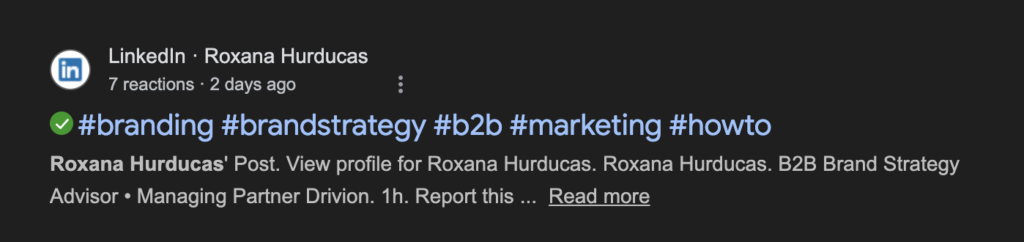
This wasn’t about distribution tricks, but about publicly indexed content. Google extracted those tags and displayed them as part of the result description.
Hashtags no longer have the power they once had in the LinkedIn algorithm – they are no longer a distribution engine. I continue to use them as positioning tools – Branding, Brand Strategy, B2B, Marketing, and How To are the labels I intentionally associate with the content I create.
Google indexed them and linked them to my name, extending this positioning beyond LinkedIn. Well done, Roxana! 😎
Google builds an identity about you, even if you don’t consciously build it
For Google, hashtags are semantic signals. If a name consistently appears associated with certain concepts, the search engine starts linking those concepts to that person or company.
I’ve written before about how repetition creates association, and association creates positioning.
The question is: what do you want to be associated with?
Hashtags: what they were, what they’ve become, and why they still matter
Between 2016-2020, on LinkedIn, hashtags functioned as a distribution tool. If you used #logistics or #transport, your post could reach the feeds of those following that hashtag.
Naturally, “success formulas” appeared: 3-5 hashtags, 10 hashtags, placed at the beginning or end, combined with popular hashtags, and so on.
Over time, LinkedIn’s algorithm changed. Today, distribution is influenced much more by relevance to your network, early engagement, time spent on the post, and the relationship between the author and the audience.
Hashtags haven’t disappeared, but they are no longer the main reach accelerator. Today, they function differently: as thematic labels, tools for consistency and positioning, and, as we’ve seen, as semantic signals for search engines.
For Google, a hashtag is simply a visible keyword, clearly marked in the structure of a page. If you repeat it consistently in association with your name or your company, it becomes part of your digital identity.
The problem isn’t that hashtags “don’t work anymore,” but that most companies use them without intention.
“And how does this help me, Miss?”
Few companies search their own name on Google from a strategic perspective. Most search for rates, tenders, competitors, legislation, but rarely ask, “What does Google say about me?”
Yet for a new client, a potential partner, or an investor, Google is often the first credibility filter – before a call, an offer, or a meeting.
Google doesn’t just display revenue figures or official data, it also shows semantic association. If your company name consistently appears in contexts of crises, disputes, complaints, conflicts, Google learns that.
And if it consistently appears in contexts of expertise, technology, efficiency, strategic clarity, leadership, Google learns that too.
Search engines don’t express opinions – they reflect consistency (or the lack of it).
Positioning is no longer just in the market. It’s also in the index.
Your brand is no longer just what you say in presentations, on your website, or on social media, it’s also what Google understands about you.
And Google learns from interviews, media appearances, public social media posts, press releases, articles, and yes, hashtags.
Many companies communicate in fragments: today about a new truck, tomorrow about recruitment, the next day about a contract won. There is no clear territory.
And when there is no clear territory, Google cannot build a clear association.
What have you repeated often enough for Google to learn about you?
In conclusion
Hashtags are no longer a distribution channel, but a positioning tool within the index.
And the index doesn’t forget and doesn’t forgive.
Mini-framework: How to choose 5 strategic hashtags for your brand
If hashtags are no longer about reach but about semantic association, then they must be chosen strategically – not intuitively. That means you don’t choose what’s popular, what others use, or what sounds good. You choose what you want the market – and Google’s index – to remember about you.
Here’s how:
1️⃣ Start from your brand positioning, not from social media
What do you want your brand to be known for? Write down 3-5 concepts that define your strategic direction. Not services, not products, but direction. For example:
- digitalization
- operational efficiency
- leadership
- strategy
- optimization
- safety
- innovation
These become your core.
2️⃣ Avoid overly generic terms
#business or #success don’t build positioning. They are too generic, too diffuse, too overused.
A strategic hashtag is:
- clear enough
- specific enough
- repeatable enough
3️⃣ Build consistency through repetition
In positioning, power comes from consistency, not variety. If today you use #strategy, tomorrow #consulting, the next day #growth, then #innovation, without a common thread – you don’t build association.
Choose 3, maximum 5 and use them consistently. Google will learn.
4️⃣ Align hashtags with real content
You can’t occupy a direction just declaratively. Positioning is a promise you must honor with actions.
If you use #leadership but only post operational updates, dissonance appears.
5️⃣ Think long-term
The question is not “Which hashtags help me today?” but “Which concepts do I want associated with my name two years from now?”
How we apply this at DRIVION
At DRIVION, we consistently use #transport #logistics #B2B #marketing because they define the intersection where we operate.
#transport and #logistics mark the industry where we have direct experience and where we build positioning for our clients.
#B2B defines the type of business we understand and for which we design strategy.
#marketing clarifies the nature of our intervention.