
How the 6-year re-evaluation works and what it means, in practice, for toll costs.
There is a question that constantly appears in discussions about CO₂ taxation and which, every time, comes with a dose of anxiety: if I buy a truck today classified in CO₂ taxation class 3, how long will it take to reach class 2 or even class 1?
The question is not just technical. It is rather a financial, strategic question, about investments made over five or six years, about leases calculated to the cent, and about margins that can be affected by differences of over a hundred euros per transit in Germany.
And yet, the answer is not found in a fixed date on the calendar.
To understand what is happening, we need to shift perspective slightly.
Imagine a high jumper. The truck is the athlete and its CO₂ emissions value from the Certificate of Conformity is the real performance, i.e., how high it can jump. That value is fixed; it does not change every year, it is not recalibrated at every service, it does not increase or decrease based on taxes.
However, the bar it has to jump over does not stay at the same height.
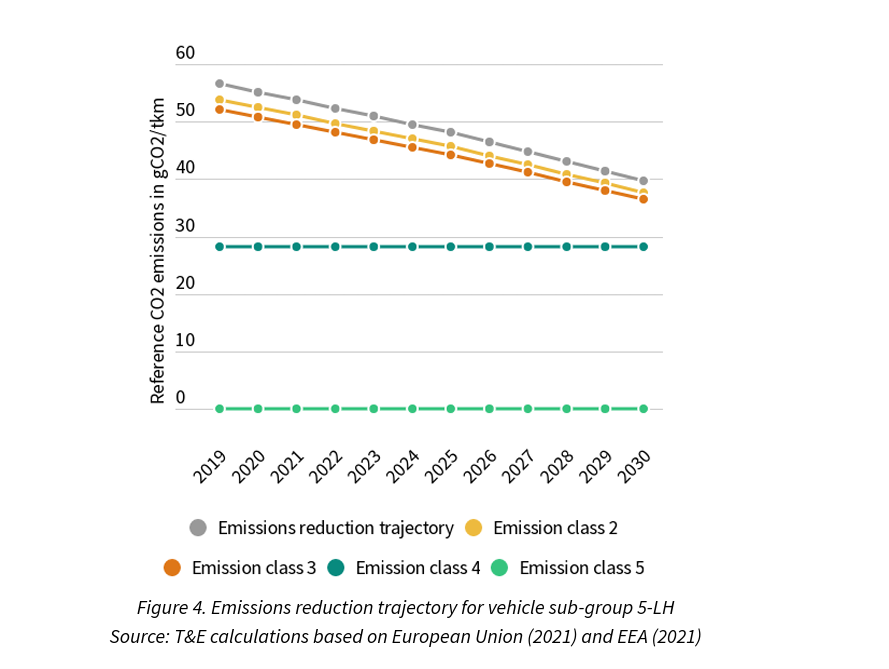
European standards for heavy-duty vehicles stipulate a progressive reduction in the reference values for emissions. The threshold decreases annually, which means that the technical performance of the truck is reported, year after year, against an increasingly demanding standard. The athlete jumps the same, but the competition gets tougher.
The moment the truck is registered in a toll system, such as the one in Germany, the CO₂ class is established based on the official value in the CoC and is stored in the system. There is no annual physical check; no one is called to “retest” the truck. The tariff applied to each transit is automatically determined based on the registered class.
Where does reclassification then occur?
For vehicles in classes 2 and 3, a re-evaluation is scheduled six years after the first registration. This is an administrative check—the system compares the fixed emissions value with the thresholds valid at that moment. If the difference is no longer sufficient to maintain the classification, the vehicle is moved to the lower class.
It is essential to emphasize one thing crucial for the industry: this reclassification does not happen annually and cannot occur sooner than six years from the date of first registration. The fact that standards become stricter every year influences the level of the reference thresholds, but the actual change in a vehicle’s class happens within this programmed re-evaluation mechanism.
Therefore, the truck does not “drop” from one year to the next just because the bar has been raised; it is re-evaluated at the moment established in the system’s architecture, and the standard valid in that year is applied then.
A simple example helps more than any formula. If in 2019 the reference was around 56.6 g CO₂/tkm, and the trajectory progressively descends to approximately 39.6 g CO₂/tkm in 2030, a truck with 48 g CO₂/tkm can be comfortably classified in a higher class at the time of purchase. However, upon completion of the six years, the system will compare that 48 g CO₂/tkm value with the threshold valid in the year of re-evaluation. If, in the meantime, the standard has fallen below the truck’s performance level, the classification will change.
The truck has not technically degraded; its performance is the same. The context has changed. This is the essence of the mechanism. Reclassification is not a penalty and not an arbitrary surprise. It is the effect of a European framework that pushes the industry towards increasingly lower emissions and transforms today’s performance into a relative performance tomorrow.
From this perspective, the correct question for a fleet manager is not “in how many years will my truck fall into class 1?”, but “where do I stand today relative to the threshold and how much security does this positioning offer me for the moment of re-evaluation?”. The difference between a truck that exceeds the threshold by 1% and one that exceeds it by 10% is not theoretical. It is the difference between stability and vulnerability in an evolving taxation context.
In an industry where costs are rising, where ETS2 will influence the price of diesel, and where European states are gradually aligning taxation systems with the CO₂ component, the purchase decision becomes more than a choice between two commercial offers. It becomes a positioning decision on a trajectory that is increasingly strict year after year.
The bar will not be lowered—quite the opposite.
In this context, the technical performance of the truck must be evaluated not only against today’s standard but also against the standard that will be applied at the time of re-evaluation.
In conclusion, within an increasingly strict European framework, decisions should no longer be made based only on the purchase price, but on correct information and a clear understanding of the underlying mechanisms. For transport companies, being well-informed has become a condition for stability.
At Drivion, we work exactly in this intersection zone between regulation, positioning, and financial impact—where technical specifications become strategic decisions. Because, in a moving system, clarity makes the difference between a predictable investment and a vulnerable one.